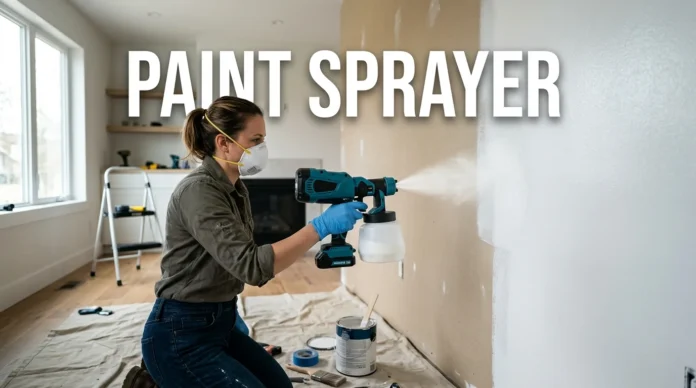
A paint sprayer can save time on the right DIY job, but buying the wrong type can lead to excessive masking, frequent refills, and a finish that takes practice to control. For most homeowners, the choice comes down to HVLP, airless, or a compact cordless system.
Short answer: choose HVLP for furniture, trim, and smaller garden jobs where control matters. Choose airless for large walls, ceilings, and exterior areas where speed matters. A cordless cup system suits quick touch-ups, while a roller still makes more sense for a single furnished room where extensive masking would erase the time savings.
| System | Best suited to | Current UK example price | Best point | Main trade-off |
|---|---|---|---|---|
| Compact corded HVLP | Furniture, trim, fences, sheds | About £44 to £75 | Good control for smaller jobs | Slower across whole rooms |
| Higher-output HVLP | Doors, cabinets, larger DIY projects | About £119 to £157 | More output while retaining control | More equipment to clean |
| Cordless handheld | Small jobs and awkward locations | Around £55 and up | Easy to carry between work areas | Smaller paint capacity |
| DIY airless | Walls, ceilings, fences, and exteriors | About £270 to £840 | Fast coverage over large areas | More masking and practice required |
| Roller and brush | Single rooms and touch-ups | Low initial tool cost | Simple setup and control | Slower across large open areas |
These are example UK prices checked on 19 August 2026 rather than fixed market ranges. B&Q listed Wagner and Erbauer systems from roughly £44 to £150, while current comparison listings included Bosch and Wagner units priced at around £119 to £157. Specialist airless models ranged from about £270 to more than £800.
Which type of paint sprayer suits your project?
The best system depends less on the brand and more on what you expect to coat. Surface size, finish quality, paint thickness, and how often you plan to spray all matter.
HVLP works well for furniture, trim, and controlled DIY jobs
HVLP stands for high volume, low pressure. These systems are commonly used where control and finish matter more than maximum coverage speed.
Furniture, doors, window trim, garden furniture, and smaller fences are sensible matches. Compact HVLP equipment is also widely marketed to first-time DIY users because the work area is easier to control.
That makes this type a practical starting point if your plans include several small decorating jobs rather than repainting entire properties.
Before refinishing older furniture or woodwork, preparation still matters. Deco Home’s guide to removing old coatings before refinishing explains the paint-stripping step that may be needed before applying a fresh finish.
Airless systems make more sense for large surfaces
Airless machines are designed for coverage speed. They suit larger walls, ceilings, exterior surfaces, long fences, and other areas where repeatedly filling a small cup would become frustrating.
Current guidance on comparison also distinguishes the two systems in this way. HVLP is better suited to smaller, detailed work, while airless equipment is more suitable for walls, decking, and extensive fencing.
The trade-off is preparation. Faster application does not mean the entire decorating job becomes equally fast. Nearby floors, windows, sockets, furniture, and adjoining surfaces still need protection.
Cordless systems prioritise portability
A handheld cordless model can make sense when access matters more than capacity. It is easier to move around garden furniture, sheds, or several small areas without having to manage a long mains lead.
Current UK listings include cordless options at the lower end of the market, although batteries, chargers, and included accessories vary by package. Check exactly what comes in the box before comparing prices.
For an outdoor refresh, Deco Home’s budget small garden makeover ideas can also help you decide whether repainting fences, furniture, or other features is worth including in the wider project.
What current UK prices tell you
You do not need the most expensive machine for every decorating task. The useful question is whether the extra cost solves a problem you are likely to face.
A £50-£75 system may be enough for occasional furniture, fencing, or shed work. Higher-output HVLP equipment starts to make more sense when you want to tackle doors, larger timber areas, or repeated projects.
Choosing airless equipment sharply increases the budget. Specialist retailers currently list DIY-focused machines from roughly £270, with more capable systems costing £400, £500, or more.
That extra expense is easier to justify when you have several large areas to coat. Buying a high-output machine for one small bedroom is harder to justify.
7 Buying checks before you spend
- Match the system to your largest regular project. Furniture and trim favour control, while full walls and long fences place more value on output.
- Check coating compatibility. Read the manufacturer’s guidance for emulsion, wood treatments, varnish, primer, or other coatings you expect to use.
- Look at flow and nozzle adjustment. Greater control helps when moving between narrow trim and broader panels.
- Consider paint capacity and hose length. Frequent refilling becomes noticeable during large jobs.
- Check how the machine is cleaned. A tool that is awkward to flush may become one you avoid using.
- Budget for the full setup. Masking materials, filters, and suitable personal protective equipment can add to the real project cost.
- Compare buying with hiring or rolling. If the machine will be used only once, ownership may not provide the best value.
Preparation and cleanup can decide whether spraying saves time
The speed advantage is most obvious once application begins. However, the preparation required beforehand can be substantial.
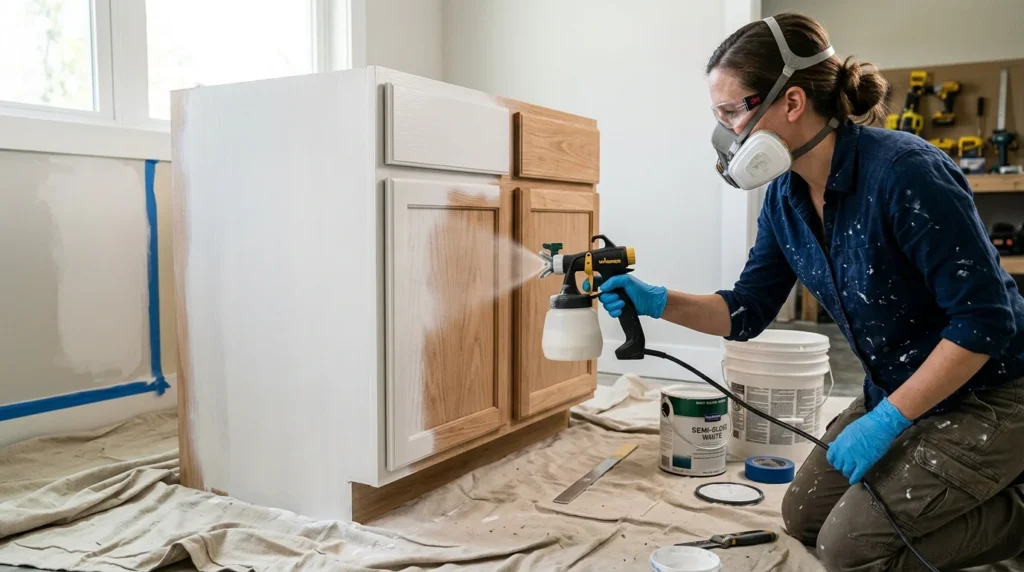
Rooms need careful masking because fine spray can travel beyond the target surface. Furniture may need to be moved, and nearby trim, flooring, switches, and glass need protection. Current decorating guidance also recommends practising the spray pattern before starting on the visible area.
Cleaning matters at the end of the job as well. Paint left inside a nozzle, hose, or fluid path can cause problems the next time you use the machine. This is why a quick test on cardboard or scrap material pays off. You can adjust the flow, movement, and distance before coating the finished surface.
If decorative trim is part of the room, Deco Home’s guidance on painted window trim provides useful design context before you decide which surfaces to spray and which to finish by hand.
Do you need to thin emulsion before spraying?
There is no single dilution ratio that works for every machine and every type of paint. Wagner’s guidance says thicker materials may need dilution, citing up to 10% as an example, depending on the coating. B&Q also advises checking viscosity and testing the material rather than assuming every paint requires the same treatment.
Follow both the coating manufacturer’s instructions and the equipment manual. Adding too much water can affect coverage and finish, while material that is too thick may not atomise correctly. A viscosity test or small trial spray is more useful than copying a fixed ratio from another DIY project.
When spraying beats a roller, and when it does not
Spraying becomes attractive when the surface is large, repetitive, or awkward to cover with a brush. Fences, textured surfaces, multiple doors, and open rooms can all benefit from quicker application. A roller remains a strong choice for a single furnished room. Setup is simple, paint control is familiar, and you avoid masking the room to the same extent. Roller application also has a shorter learning curve for many occasional decorators.
Frequency matters too. If you decorate often, buying equipment becomes easier to justify. For one project, hiring equipment or using traditional tools can be cheaper and simpler. The fastest application method is not always the fastest way to complete the entire project. Count setup and cleanup time as well as the time spent applying paint.
Our verdict: choose for the job, not the biggest specification
For furniture, trim, doors, and smaller fence projects, HVLP is a strong all-round starting point for many DIY users because it prioritises control. For repeated whole-room projects, ceilings, exterior walls, or extensive fencing, airless equipment is the more logical step up. Its higher cost is easier to justify when large coverage areas are a regular part of your plans.
Choose a cordless system mainly when mobility is the problem you need to solve. For a one-off furnished room, a good roller may still provide the simpler and cheaper solution. None of these recommendations depends on claiming that one product is universally best. They are based on project suitability, current UK pricing, and the practical differences between the main system types.
For more planning ideas about finishes, colours, and interior details, browse Deco Home’s Decoration guides before starting your next room.
Your next step
Start by listing the surfaces you expect to decorate during the next year. If most are furniture, trim, or garden features, compare compact HVLP systems first. If several large walls, ceilings, or exterior areas are waiting, compare airless options. Then check compatible coatings, cleaning requirements, included accessories, and replacement parts before ordering. The right tool is the one that fits your actual project routine, not the model with the longest specification sheet.
Frequently asked questions
It can be if you have several suitable projects. Furniture, fences, doors, sheds, and multiple rooms give the equipment more opportunities to repay its cost. For one small job, hiring equipment or using a roller may make better financial sense.
Many systems can handle emulsion, but compatibility varies. Thick material may need controlled dilution. Check the coating instructions, machine manual, and viscosity guidance before adding water.
HVLP is usually the better fit for furniture because the work calls for controlled application over a smaller area. Airless equipment offers greater advantages on larger surfaces, where speed and output matter more.
Current entry-level UK options start at around £50, while higher-output home systems can cost £100 to £160 or more. Airless equipment often costs several hundred pounds. Buy based on the projects you expect to complete, rather than choosing the highest specification available.
Application can be much faster over large or awkward areas, but the total project time depends on masking, setup, and cleanup. A roller can remain quicker overall when the room is small, furnished, or difficult to protect.