
Sheep’s wool insulation is a natural, renewable insulation made from wool fibres, usually supplied as rolls or slabs for lofts, timber stud walls, and suspended floors. It insulates about as well as glass mineral wool (typical thermal conductivity around 0.035 to 0.040 W/mK), handles moisture better, and is pleasant to install, but it costs noticeably more and needs proper insect-proofing treatment. Here is what UK homeowners should know before choosing it.
| Feature | What to expect |
|---|---|
| Material | Washed sheep’s wool, often blended with a proportion of polyester binder fibres |
| Thermal performance | Typically around 0.035 to 0.040 W/mK, similar to many mineral wool rolls |
| Moisture | Absorbs and releases water vapour; one leading UK product quotes around 30% absorption by weight at 100% humidity |
| Forms | Rolls, slabs, and loose wool; common thicknesses from 50mm to 150mm or more |
| Best uses | Lofts, timber stud walls, rafters, suspended timber floors, older breathable buildings |
| Main drawbacks | Higher price, needs insect-proofing, thicker than rigid boards for the same performance |
What is sheep’s wool insulation?
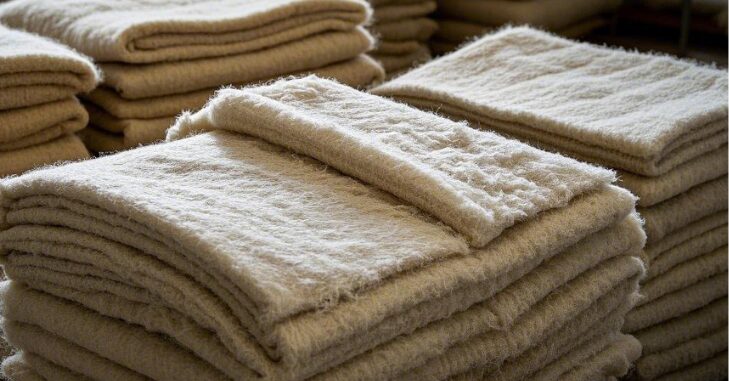
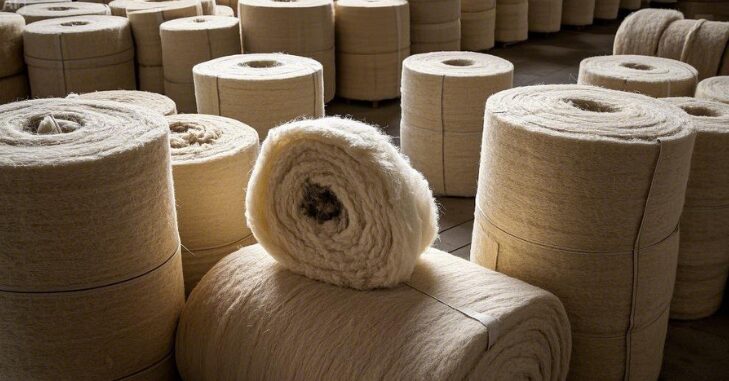
Wool insulation is made by scouring (washing) fleece, treating it against moths and beetles, and bonding the fibres into flexible batts or rolls. Much of the wool used is coarse fleece that has little value for clothing, which gives farmers a use for a by-product. Some products are close to pure wool; others mix in polyester fibres to hold their shape, so check the wool percentage on the product data sheet if natural content matters to you.
How well does it insulate?
In the UK, insulation performance is described by thermal conductivity (lambda, in W/mK): the lower the number, the better. Wool products typically sit around 0.035 to 0.040 W/mK. One widely sold UK wool roll, for example, is tested at 0.039 W/mK. That puts wool in the same range as glass and stone mineral wool, but well behind rigid PIR boards (often around 0.022 W/mK), which achieve the same performance in much less thickness.
You may see American articles quote an “R-value of 3.5 per inch”. That is the US imperial measure and is consistent with the figures above, but UK suppliers and Building Regulations work with lambda values and U-values, so compare products using those.
For lofts, the commonly recommended total depth of quilt insulation in the UK is 270mm. With wool, plan for a similar depth, built up in layers: one between the joists and one laid across them. If you want to store things in the loft afterwards, use raised loft boards rather than squashing the insulation, because compressed wool loses much of its insulating value.
Moisture: wool’s biggest advantage
Wool is hygroscopic: it absorbs water vapour from humid air and releases it again as conditions dry. Manufacturers’ test data shows significant absorption (one UK product quotes 30% by weight at 100% relative humidity) without the material collapsing. This buffering helps even out short-term humidity swings in roof spaces and timber structures.
This is why wool is popular in older, solid-walled and timber-framed homes that rely on “breathable” construction. It is not a substitute for fixing leaks, rising damp, or poor ventilation, though. Insulation that stays wet for long periods will perform badly whatever it is made of. If you already have condensation problems, deal with those first; a damp survey can pinpoint the cause.
Comfort, sound, and indoor air
Sound absorption
Like other fibrous insulation, wool absorbs airborne sound well when packed into stud walls and between floor joists. It helps reduce noise between rooms and floors, though serious soundproofing also depends on mass (for example extra plasterboard layers) and sealing air gaps.

Handling and installation
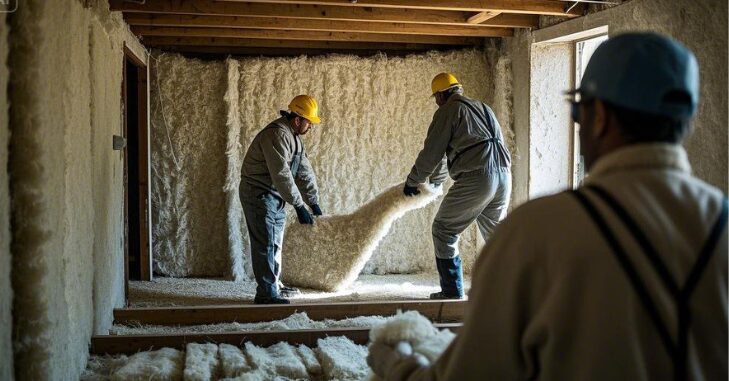
Many people choose wool because it does not cause the itching that glass fibre often does. It is soft to handle and easy to cut. Sensible precautions still apply: wear gloves and a dust mask in a dusty loft, and take care around electrics.
Indoor pollutants
Laboratory research has found that wool fibres can absorb and chemically bind some indoor pollutants, notably formaldehyde. It is a genuine property of the fibre, but insulation hidden in a loft or wall cavity has limited contact with room air, so treat it as a small bonus rather than a reason to skip good ventilation.
Fire safety
Wool is naturally harder to ignite than many fibres and tends to char and self-extinguish rather than melt or drip. One UK product data sheet, for instance, quotes an ignition point of 560°C. However, wool insulation is still a combustible material, and fire performance varies by product and treatment. Check each product’s declared fire classification and make sure it is suitable for where you plan to use it, particularly near chimneys, flues, recessed downlights, and in external walls, where Building Regulations set specific requirements.
Sustainability: the real picture
- Renewable: sheep grow a new fleece every year, and UK products often use British wool.
- Low embodied energy: manufacturers’ life-cycle data typically shows low production energy compared with many synthetic insulations, and wool stores biogenic carbon.
- End of life: pure wool is biodegradable, but products with polyester binders or chemical treatments are not fully so; reuse is often the best option.
- Trade-offs: sheep farming has its own environmental footprint, and wool usually needs more thickness than rigid boards, which matters where space is tight.
Where you can use sheep’s wool insulation
Lofts
The most common use. Rolls lay between and over joists in a cold loft. Keep eaves ventilation clear so the roof space can still air out, and leave gaps around recessed lights or use fire-rated covers.
Timber stud walls and rafters
Slabs friction-fit between studs or rafters, providing both thermal and acoustic insulation. In a warm pitched roof, the build-up needs careful design (membranes, ventilation gaps, and possibly extra insulation over or under the rafters) to meet current standards.
Suspended timber floors
Wool can be supported between joists with netting or battens. Ventilation of the underfloor void must be maintained, or the timbers can be put at risk of rot.
Older and listed buildings
Wool’s vapour-open nature suits traditional construction. For listed buildings, speak to your local conservation officer first, as consent may be needed. For solid walls, external or internal wall insulation systems are a separate decision; see our guide to external wall insulation for that option.
How it compares with other insulation
| Feature | Sheep’s wool | Glass mineral wool | PIR board |
|---|---|---|---|
| Typical thermal conductivity | About 0.035 to 0.040 W/mK | About 0.032 to 0.044 W/mK | About 0.022 W/mK |
| Renewable | Yes | No (largely mineral and recycled glass) | No (petrochemical) |
| Moisture buffering | Good | Poor | Very low (closed cell) |
| Comfort to handle | Soft, non-itchy | Can irritate skin | Dust when cutting |
| Relative cost | High | Low | Medium to high |
| Best for | Lofts, timber structures, breathable buildings | Budget loft and wall insulation | Where space is tight |
Drawbacks and how to manage them

- Cost: wool usually costs several times more per square metre than basic mineral wool loft roll. Energy savings come from the insulation depth, not the material, so wool will not pay back faster than a cheaper product of similar performance. People choose it for its other qualities.
- Insects: untreated wool attracts clothes moths and carpet beetles. Buy products tested and treated for insect resistance; older borax treatments were less durable than modern ones. If you have had carpet moths in the house, this matters even more.
- Rodents: no insulation stops mice and rats. Seal entry points rather than relying on the material.
- Availability: large DIY chains stock it less often than mineral wool, so you may need a specialist eco-building supplier.
Tips for buying and installing
- Compare products by lambda value and thickness, then calculate the depth you need.
- Check the wool percentage, insect treatment, and fire classification on the data sheet.
- Fit snugly with no gaps, but do not compress the wool.
- Keep it dry during storage and installation.
- For walls, roofs, and floors in an extension or major renovation, check Building Regulations requirements with your builder or building control.
Is sheep’s wool insulation worth it?
If budget is the main concern, mineral wool delivers similar thermal performance for much less money. Sheep’s wool earns its premium when you value a natural, renewable material, easier handling, and good moisture behaviour, especially in older, timber, or breathable buildings. Choose a treated, well-documented product, install it at the right depth without compressing it, and it will perform well for many years.
Frequently asked questions
Is sheep’s wool insulation better than mineral wool?
Thermally they are similar. Wool handles moisture better, is renewable, and is more pleasant to install, while mineral wool is much cheaper and easier to find. Which is better depends on your budget and building.
How thick should sheep’s wool loft insulation be?
The usual UK recommendation for loft insulation is a total of 270mm, laid in two layers: one between the joists and one across them. Check the product’s lambda value, as a slightly different depth may be needed for the same performance.
Does sheep’s wool insulation attract moths?
Untreated wool can. Commercial wool insulation is treated against moths and beetles, so choose a product with tested insect resistance and keep the loft dry and well ventilated.
Is sheep’s wool insulation fireproof?
No insulation made from fibres is fireproof. Wool is naturally hard to ignite and tends to self-extinguish, but you should check each product’s fire classification and keep it away from heat sources such as flues and recessed lights.
Can sheep’s wool insulation be used in older homes?
Yes. Its vapour-open, moisture-buffering nature suits traditional and timber-framed buildings. For listed properties, check with your conservation officer before starting work.
For more home improvement ideas, see our Interior design category.