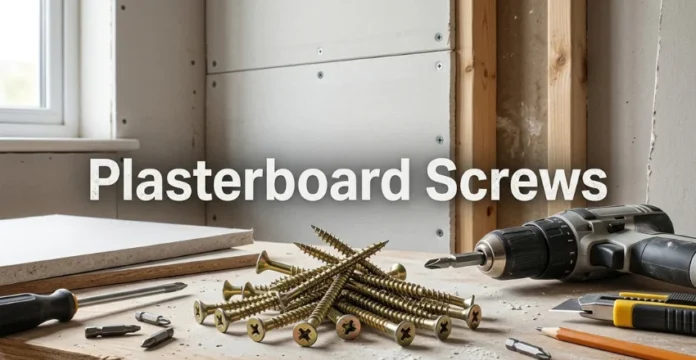
Plasterboard screws look simple, but thread type and length affect how securely boards sit. UK buyers should match the fixing to timber or metal framing before choosing a pack. This guide explains the sizes, spacing, prices, and fitting details that matter most.
Use coarse-thread drywall fasteners for timber studs and fine-thread versions for light-gauge metal. British Gypsum advises 25mm minimum penetration into timber and 10mm into Gypframe metal. For 12.5mm board, 38mm often suits timber and 25mm often suits metal. Follow the tested system if it specifies another fixing.
| Decision | Practical UK answer |
|---|---|
| Timber framing | Choose a coarse thread |
| Light-gauge metal framing | Choose a fine thread or specified self-tapping type |
| 12.5mm board to timber | 38mm is a common starting point |
| 12.5mm board to metal | 25mm is a common starting point |
| Partition spacing | Often 300mm centres |
| Ceiling spacing | Often 230mm in the field and 150mm at board ends |
| Common drive | Phillips PH2 on many UK products |
| Pack format | Loose or collated, commonly in large trade packs |
Key Takeaways
- Match the thread to the frame before choosing the length.
- Allow enough penetration into the supporting timber or metal.
- Follow the board manufacturer’s tested system for fire or acoustic constructions.
- Set each head without tearing the paper face.
- Keep board-fixing fasteners separate from cavity fixings used for shelves or TVs.
- Check live stock and pricing before ordering because ranges change.
What These Fasteners Are Designed to Do
Drywall fasteners hold gypsum board against timber studs, joists, metal studs, or ceiling channels. Their sharp points help them start quickly without a large pilot hole. A bugle-style head spreads pressure across the paper face while seating neatly.
That head shape matters because plasterboard depends on its paper liners for surface strength. A fixing driven too deeply can break the face and weaken that fixing point. The aim is a neat recess that remains ready for jointing compound or skim.
How to Choose Plasterboard Screws by Frame and Board
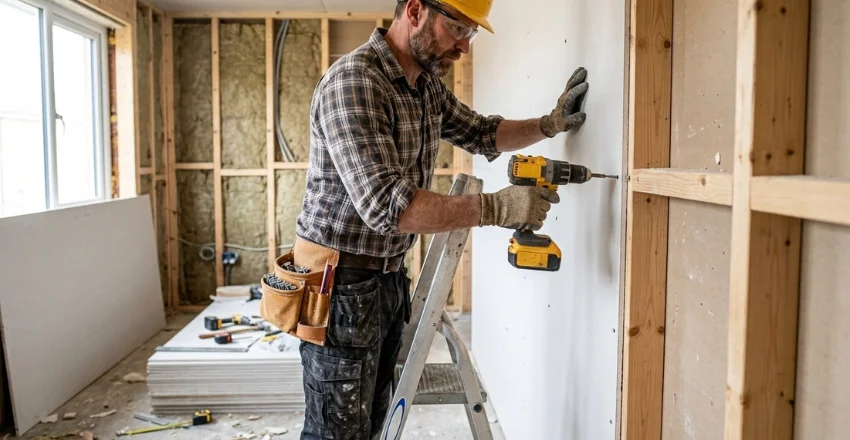
Start with the frame material, then check board thickness and the number of layers. Those two checks narrow the choice faster than brand names or pack colour. The project specification should make the final decision for tested systems.
Timber Studs and Joists
Coarse-thread drywall fasteners suit timber because the wider thread bites into wood fibres. British Gypsum states that its fixing length should include at least 25mm into timber. That rule makes 38mm a sensible option for many single 12.5mm board installations.
Ceilings deserve the same careful selection because gravity works against the board. Check the ceiling system before using a wall fixing schedule. Fire-rated or acoustic layers may also require longer products and tighter system control.
Metal Studs and Channels
Fine-thread or specified self-tapping fasteners suit light-gauge metal framing. British Gypsum uses a minimum 10mm penetration rule for its Gypframe metal systems. Knauf also lists self-tapping products for light-gauge metal up to 0.7mm thick.
Heavier steel can need a self-drilling point rather than a standard needle point. Knauf lists Jackpoint products for metal from 0.7mm to 1.2mm thick. Check the framing gauge before buying because visually similar products can serve different substrates.
Which Length Should You Buy?
Length should cover the board build-up and still reach the frame properly. British Gypsum gives separate minimum penetration figures for timber and metal. These provide a better starting point than choosing the most common box on a shelf.
| Board build-up | Frame | Practical starting point | Reason |
|---|---|---|---|
| 9.5mm single layer | Timber | 38mm | Clears the board and reaches well into timber |
| 12.5mm single layer | Timber | 38mm | Gives about 25mm of timber penetration |
| 12.5mm single layer | Light metal | 25mm | Clears the board and meets the metal penetration rule |
| 15mm single layer | Timber | 42mm | Allows useful timber penetration |
| Multiple layers | Timber or metal | System-specific | Total build-up changes the required length |
These examples are starting points, not universal specifications. Board type, frame gauge, fire performance, and acoustic performance can change the required fixing. Use the latest manufacturer detail whenever the wall or ceiling forms a tested system.
How Far Apart Should the Fixings Be?
British Gypsum gives 300mm centres as general partition guidance and 200mm at external angles. Its general ceiling guidance uses 230mm centres in the field and 150mm at board ends. The company also warns that individual systems can use different fixing schedules.
Position matters at the board edge as well. British Gypsum specifies at least 13mm from cut edges and 10mm from bound edges in timber systems. Keep the head flush without breaking the paper or gypsum core.
A regular fixing pattern also makes later finishing easier. Mark stud or joist positions before lifting the board into place. This reduces missed framing and keeps the fixing lines easy to inspect.
Do You Need a Pilot Hole or Specialist Tool?
Many dedicated drywall products are self-tapping, so standard board fixing often needs no separate pilot hole. A screwgun gives reliable depth control on larger jobs. A drill-driver with careful torque control can also suit smaller domestic projects.
Check the drive type before starting because many UK products use PH2 heads. Knauf lists PH2 on its common plasterboard range and includes a bit with some boxes. A fresh, correctly matched bit reduces slipping and damaged heads.
Depth control matters more than driving speed. Stop when the head sits neatly without cutting through the paper liner. If the face tears, add a sound fixing nearby, following the system guidance.
Board Fixing Is Different From Hanging Items on Finished Plasterboard
Board installation and wall mounting are two different jobs. Drywall fasteners secure the board to the frame behind it. They are not a general replacement for anchors used to support shelves, cabinets, mirrors, or televisions.
For a mounted item, aim for a stud where the design allows. Otherwise, choose a cavity fixing rated for the board thickness and expected load. Heavy or projecting loads may need framing, pattressing, or professional assessment.
This distinction matters during feature-wall projects because the finished surface may carry expensive equipment. Plan support positions before closing the wall. DecoHome’s media wall ideas guide also covers layout, cable access, storage, and practical planning.
What Do They Cost in the UK?
Retail prices vary by brand, coating, thread, and whether the product is collated. Wickes listed current examples across fine and coarse thread options on 20 September 2026. Its range included 500-piece and 1,000-piece packs in several common lengths.
| Current Wickes example | Pack | Listed price |
|---|---|---|
| Fine thread black phosphated 32mm | 1,000 | £12.60 |
| Fine thread black phosphated 38mm | 1,000 | £12.00 |
| Coarse thread black phosphated 38mm | 500 | £9.45 |
Treat these figures as a snapshot, not a guaranteed checkout price. Local stock and promotions can change quickly. Compare the current Wickes range and check local availability before ordering.
Loose packs work well with a normal screwgun or drill-driver. Collated strips suit compatible auto-feed tools and can speed repetitive boarding. Some professional packs also include a driver bit, so check the box contents before buying extras.
Common Mistakes That Cause Weak Fixings
Most failures start with selection or driving, not the plasterboard itself. A few checks prevent repeated holes, damaged faces, and loose boards. They also help you avoid buying a large box that does not suit the frame.
- Using coarse thread into metal framing.
- Using fine thread where a timber-specific fixing is required.
- Choosing a length without checking the total board build-up.
- Driving the head through the paper face.
- Spacing fixings wider than the selected system allows.
- Treating a board fastener as a heavy-load wall anchor.
- Ignoring manufacturer instructions on fire-rated or acoustic constructions.
Standard black-phosphate products are widely used for internal drylining. Damp, exposed, or specialist environments may require a different specified finish or system. Follow the board and framing manufacturer’s detail rather than assuming one coating suits every room.
Where These Fixings Fit Into Wider Renovation Work
Boarding often follows insulation, first-fix services, and framing. That sequence means you should settle hidden support and service routes before the surface closes. DecoHome’s sheep’s wool insulation guide gives useful context for insulation placed between studs and joists.
Loft projects also show why the supporting structure matters before fixing any board. Flooring panels and plasterboard serve different purposes, even when both meet timber joists. DecoHome’s loft boards guide explains storage flooring, insulation clearance, and structural planning in more detail.
Feature walls add another layer because they can hide sockets, cables, brackets, and backing supports. Decide those positions before plasterboard covers the frame. Good planning reduces later cutting, patching, and avoidable damage.
How to Buy the Right Pack
Use a short checklist before checkout. It takes less time than returning the wrong box. It also keeps price comparisons focused on products that suit the job.
- Identify timber, light-gauge metal, or heavier steel framing.
- Confirm the board thickness and number of layers.
- Calculate the required penetration using the selected system.
- Check the specified spacing and estimate the quantity.
- Choose loose or collated format for your tool.
- Confirm the drive type and required bit.
- Check current UK stock and price before ordering.
Don’t choose by length alone, as identical lengths can have different threads or points. Compare the product description against your frame and board specification. Then order enough for the job plus a small allowance for waste and damaged fasteners.
Frequently Asked Questions
What Size Plasterboard Screws Should I Use for 12.5mm Board?
For 12.5mm board on timber, 38mm is a common UK starting point. British Gypsum’s guidance requires board thickness plus at least 25mm into timber. For light-gauge metal, 25mm often works if it meets the selected system’s requirements.
Can I Screw Directly Into Plasterboard to Hang Something?
A normal fastener driven only into gypsum has limited reliable support. Use a suitable cavity fixing when no stud sits behind the mounting point. For heavy items, follow the product’s load guidance, and you may need structural support.
How Many Fixings Do I Need Per Sheet?
The number depends on board size, framing centres, edges, and whether the surface is a wall or ceiling. Use the specified centre spacing to calculate each framing line rather than relying on one universal quantity. Ceilings generally use closer centres than standard partitions.
Is Coarse Thread Better Than Fine Thread?
Neither thread is better for every job. Coarse thread suits timber, while fine thread suits appropriate metal framing. The right choice depends on the substrate providing the holding strength.
Final Check Before You Start
Confirm the frame, board build-up, fixing length, and spacing before opening the first pack. Keep the paper face intact and follow the selected manufacturer system. Then check live UK stock and buy the exact type your wall or ceiling requires.