

A track saw is built for long, straight, controlled cuts in sheet material and finished timber. It runs on a guide rail, which helps keep the cleaner blade on the intended line. Key buying choices include rail length, cutting depth, power, voltage, dust extraction, and system cost. These points matter more than headline wattage alone.
| Buying point | Practical UK starting point | Why it matters |
|---|---|---|
| Main use | Sheet goods, doors, worktops, cabinetry, and built-ins | These jobs reward straight, clean cuts. |
| Common blade size | Around 160–185mm | Blade size affects depth and replacement choice. |
| Rail length | About 1.4–1.5m for many crosscuts | Full-length sheet ripping needs longer or joined rails. |
| Power | Corded or cordless | Corded suits fixed work; cordless improves mobility. |
| Domestic voltage | Usually 240V models for household mains | Many 110V versions are intended for site transformers |
| Dust control | Extraction port plus suitable vacuum | Cutting MDF and timber creates harmful dust. |
| Budget | Roughly £80 to £850 for current examples | Rails, batteries, and cases can change the real cost. |
Quick answer: A guided plunge saw makes the most sense when accuracy matters more than rough-cutting speed. Choose the rail system before comparing headline power figures. Check whether rails, batteries, clamps, connectors, blades, and extraction fittings are included, because those extras can sharply change the final cost.
Key takeaways
- Choose the rail system around the longest cuts you expect to make.
- Check the rail’s cutting depth, not just the largest published figure.
- A 240V corded model is often the simplest choice for home workshops.
- Cordless makes more sense when you already own compatible batteries.
- Budget for extraction, clamps, connectors, and replacement blades.
What is a guided plunge saw used for?
A guided plunge saw combines a circular blade with a base designed to slide along a rail. Many models also let the blade plunge into the workpiece from above. That makes them useful for panel sizing, door trimming, worktop cut-outs, and fitted furniture. The guide rail is the main reason people buy this type of saw. Its edge gives you a clear reference for straight cuts across large panels.
A splinter strip can also support the surface close to the blade and reduce tear-out. This tool suits projects where the cut edge needs to look finished. It is especially useful with plywood, MDF, laminate, and veneered boards. It can also help with media wall ideas that use sheet material.
Track Saw vs. Circular Saw: Which One Fits Your Work?
A circular saw is usually cheaper and more flexible for general building work. It handles quick crosscuts, framing timber, and rough sheet breakdown without needing a rail. A guided plunge system is better when long cuts must stay straight and clean.
| Job | Guided plunge system | Circular saw |
|---|---|---|
| Long sheet cuts | Excellent | Good with a separate straightedge |
| Finished edges | Strong choice | Depends more on the guide and technique |
| Plunge cuts | Available on true plunge models | Usually not designed for controlled plunge cutting |
| Rough framing | Less convenient | Strong choice |
| Dust collection | Often better enclosed | Varies by model |
| Setup cost | Higher | Usually lower |
| Small workshop storage | Compact saw, but rails need space | Compact and simple |
If you mainly cut framing timber, buy a circular saw first. If you often size panels, trim doors, or fit kitchens, the guided system pays for itself faster. Many serious DIYers keep both because the tools solve different problems.
7 checks before buying a plunge saw in the UK
1. Choose the rail system before the motor.
The rail controls the longest straight cut you can make without repositioning. A 1.4m or 1.5m rail suits many door and sheet crosscuts. Full-length cuts on 2440mm boards need a longer rail or joined sections.
2. Check cutting depth on the rail.
Manufacturers may quote maximum depth without a guide rail. Usable depth can drop once the saw sits on its track. Compare the figure that matches how you will use the machine.
3. Match the blade to the material.
Blade diameter tells only part of the story. Tooth count, tooth shape, kerf, and material rating affect cut quality. Check the guidance from both the saw maker and the blade maker before changing materials.
4. Decide between corded and cordless.
Corded models give continuous runtime and often cost less than a complete cordless kit. They suit garages, workshops, and renovation jobs with reliable mains power. Cordless makes sense when you already own compatible batteries and chargers.
5. Check 240V and 110V carefully.
UK retailers often sell professional saws in both 240V and 110V versions. Domestic buyers generally need the household-mains version, while 110V site tools require a suitable transformer. Read the full model code before ordering.
6. Treat dust extraction as part of the system.
Don’t treat wood and MDF dust as a harmless mess. The Health and Safety Executive recommends effective on-tool extraction for cutting wood. Follow that advice before any repeated indoor work, and pair the saw with a suitable extractor.
7. Price the complete kit, not the saw body.
The cheapest listing is not always the cheapest usable setup. Rails, batteries, chargers, clamps, connectors, cases, and blades may be sold separately. Add those items before comparing two offers.
Four current UK examples to compare
Current UK listings show how different packages can be. We checked these prices on 22 September 2026, and they may change without notice. They are comparison examples, not claims of DecoHome hands-on testing.
| Model | Current example price | Key specification | Rail situation | Best fit |
|---|---|---|---|---|
| Erbauer ERB690CSW | £80 at Screwfix clearance | 1400W, 185mm blade, 67mm maximum depth | Two rails included | Low-cost occasional DIY |
| Einhell TE-PS 165 | £103.95 official listing | 1200W, 165mm blade, 56mm at 90° | Rail sold separately | Budget buyers wanting an expandable setup |
| Makita SP6000J | £347.99 at ITS | 1300W, 165mm blade, 55mm at 90° | Checked the listing and saw the case | Frequent DIY and trade-style interior work |
| Festool TS 55 package | £849.98 at ITS | 160mm blade, corded system | Two 1.4m rails in checked kit | Frequent professional precision work |
The current Erbauer price is unusually low because Screwfix marks it as clearance. Einhell lists a separate two-piece rail system, so its finished cost is higher. Makita and Festool sit higher because their systems include a broader range of accessories. For occasional home renovation, a complete budget kit can be enough when the rail suits planned jobs.
Frequent cabinet, door, or kitchen work can justify a stronger accessory ecosystem. Professionals should compare service support, extraction, and downtime costs before choosing by price.
How to get a clean, straight cut
- Support the workpiece so the offcut cannot drop and pinch the blade.
- Mark the finished side and place the rail on the correct side.
- Set cutting depth slightly beyond the material, following the tool manual.
- Connect extraction before starting an indoor cut.
- Let the blade reach speed before feeding the saw forward.
- Keep steady pressure on the rail and avoid twisting the saw.
- Wait for the blade to stop before lifting the tool.
A new splinter strip normally needs trimming by the saw that will use it. That first cut establishes the rail edge as a practical reference line. Follow the specific rail and saw instructions because setup details vary.
Where this tool earns its place around the home
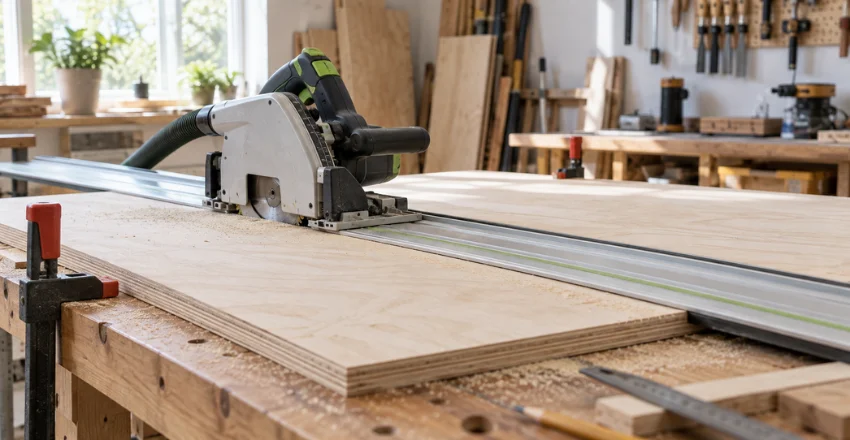
Kitchen work is a strong use case because panels and worktops need controlled edges. Compare tool spending with the wider cost of a new kitchen before buying specialist equipment. For one small job, hiring or borrowing may make more sense. Loft projects can also involve repeated panel cutting. Before cutting flooring sheets, check the structural and insulation issues in DecoHome’s loft boards guide. A precise saw does not make an unsuitable loft structure safe.
Built-in cabinetry gives the tool more chances to pay for itself. Clean MDF and plywood cuts reduce the need for filling and edge correction before finishing. DecoHome’s kitchen cupboard paint guide can help with the finishing stage.
The practical buying verdict
Start with the work, then choose the rail ecosystem that fits it. Occasional DIY users should favor a complete kit with enough rail for planned cuts. Frequent renovators should prioritize rail availability, extraction, blades, and long-term accessory support. Avoid paying for professional features you won’t use. Do not save money by accepting a rail that is too short or hard to expand. A well-matched guided saw can make panel work faster, cleaner, and easier to repeat.
Frequently asked questions
Is a track saw worth buying for DIY?
It is worth considering if you often cut sheet goods, doors, panels, or worktops. The rail saves setup time compared with repeatedly clamping a separate straightedge. For one isolated project, hiring a circular saw with a guide may cost less.
Can a guided plunge saw replace a table saw?
It can replace a table saw for many large-panel jobs. It is easier to bring the tool to a full sheet. A table saw remains better for repeated narrow rips and some joinery operations.
Do guide rails need clamps?
Many rails use anti-slip strips and can stay stable during normal straight cuts. Clamps add security on awkward surfaces, bevel cuts, or valuable finished material. Follow the rail maker’s instructions when deciding whether you need clamps.
What rail length should I buy?
Start with the longest common cut in your planned projects. Around 1.4m to 1.5m covers many door and sheet crosscuts. For 2440mm rips, choose a longer rail or compatible joined sections.
Is 240V suitable for home use in the UK?
A 240V-marketed tool is the normal retail choice for domestic mains use in Britain. Trade listings may also offer 110V versions intended for transformer use. Always confirm the exact variant before buying.